
ALBACH Research Project
Scientifically Founded High-Frequency Litz Wire Optimization
Developing the optimal high-frequency litz wire for passive components in power electronics often presents electrical engineers with complex challenges. A pioneering research project by Friedrich-Alexander University Erlangen-Nuremberg, in collaboration with PACK LitzWire, demonstrates how systematic analysis and optimization can achieve significant improvements in winding losses.
Research Focus
The project, funded by the Federal Ministry of Economics and Technology, comprehensively investigated the loss characteristics of various litz wire types from 2008 to 2011 and developed concrete optimization strategies for industrial practice. In modern sswitched-mode power supplies – ranging from PC power supplies to solar inverters – approximately one third of total system losses are attributable to inductive components. These losses result primarily from two physical phenomena: the skin effect, where current concentrates on the conductor surface at high frequencies, and the proximity effect, caused by the alternating magnetic fields of adjacent conductors.
The Challenge
A key practical challenge for developers is that commercially available litz wires are often not optimally dimensioned due to a lack of theoretical understanding regarding the complex interactions between litz wire parameters and loss characteristics. This is precisely where our scientifically founded development approach, derived from this research project, provides a solution.
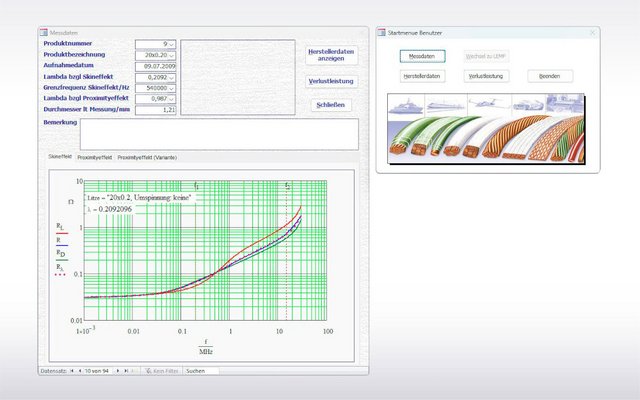
Graphic representation of research software featuring a measurement database for litz wires, including analytical evaluation of skin and proximity effects alongside technical product parameters.
Our Solution Strategy
The research team developed advanced measurement techniques to characterize different litz wire types under realistic operating conditions. Standard litz wires with similar outer diameters were compared, and the influence of specific parameters – such as lay length, lay direction, stranding type, and yarn covering – was systematically investigated.
A particularly significant milestone was the development of a comprehensive litz wire database. For the first time, this provided a sound basis for selecting optimal litz wire types for specific applications. Today, this scientific methodology allows us to determine the loss-optimized litz wire configuration for every individual application.
Result
The investigation clearly demonstrated that targeted variation of litz wire parameters can achieve substantial improvements in loss characteristics. Results were particularly significant regarding the optimization of lay length, stranding type, wire diameter, number of strands, as well as yarn covering and profiling.
Field testing in real-world transformers and inductors by the company STS showed consistently higher efficiencies when using optimized litz wire types. The project evaluation highlights the immense savings potential: in Germany alone, more than 50 GWh per year could be saved through optimized coils and transformers.
Technical questions deserve precise answers.
Would you like to find out more about the results? Please get in touch!

Product Manager