
INDUGIE Research Project - PCB Embedding
How the INDUGIE project integrates 3D coil architectures into FR4 printed circuit boards to save space – without compromising high-frequency performance.
Research Focus
A central milestone in the INDUGIE research project was the direct embedding of the developed HF litz wire into the printed circuit board (PCB). The objective was to integrate a highly efficient transmitter coil for inductive energy transfer (2 MHz) into the system environment in a mechanically robust and extremely space-saving manner.
The Challenge
Conventional printed circuit boards offer limited stack-up heights (typically 0.8–1.6 mm), which complicates the integration of coils with numerous turns. Furthermore, the embedding and subsequent encapsulation processes were required to have no negative impact on the HF characteristics of the optimized litz wire, nor generate thermal issues under continuous load.
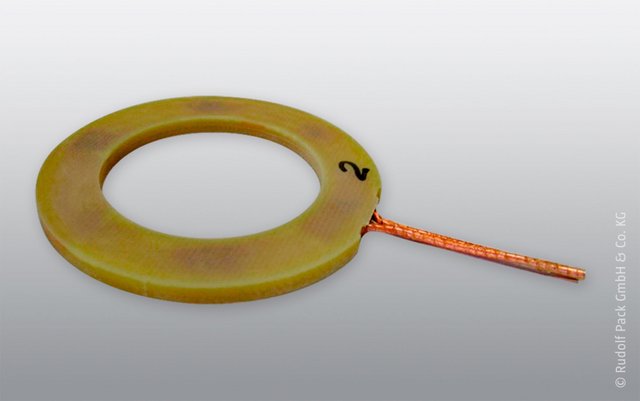
Ring-shaped printed circuit board with integrated copper litz wire as an experimental setup for investigating current distribution and electromagnetic behavior.
Our Solution Strategy
Using precision milling technology, a 1.2 mm deep cavity was created within the FR4 substrate. The 360-strand HF litz wire was precisely positioned and pressed under high pressure using temperature-stable epoxy resin. Laser-based depth control and CNC guidance ensured void-free impregnation and consistent quality.
Result
The embedding process increased the AC resistance only marginally by approximately 4%, while reducing the installation space requirement by 68% compared to conventional air-core coils. At a power level of 500 W, an efficiency of 93.4% was achieved. This demonstrates the industrial scalability of this technology for ultra-compact HF systems.

Technical questions deserve precise answers.
Would you like to find out more about the results? Please get in touch!

Product Manager