
HF Litz Wires in AC/DC and DC/DC Stages
Maximum Power Density for HPC Systems

Modern fast charging stations (HPC) are based on complex topologies with AC/DC rectification and subsequent, galvanically isolated DC/DC conversion. To achieve the required high charging power in a confined space, the thermal management of inductive components is the limiting factor. PackLitzWire supported a manufacturer in designing a winding that combines extreme power density with the necessary dielectric strength.
The Application
The overall system of a DC fast charging station consisted of an AC/DC input stage (PFC) that rectifies the grid current, and a galvanically isolated DC/DC stage that adapts the voltage to the vehicle's battery level. Both stages operated at high switching frequencies to keep the magnetic components compact. The transformers and inductors had to carry currents in the range of several hundred amperes and dissipate heat efficiently to enable charging powers of 150–350 kW (or 20–40 kW per module).
The Challenge
The requirements for the winding materials in this scenario were conflicting (trade-off):
- Loss Minimization: High HF currents and pronounced proximity effects at the used switching frequencies lead to AC losses and thus to heat.
- Dielectric Strength: Galvanic isolation in the DC/DC converter and network transients in the AC/DC stage require thick insulation layers and large creepage distances.
- Power Density: To keep charging stations compact, the copper fill factor in the winding window had to be maximized, which often conflicts with the required insulation space.
A standard solution would either thermally run away or violate the insulation requirements of the standards.
Support from PACK LitzWire
To solve this complex interplay, PACK LitzWire relied on a combination of simulation-based design and material expertise:
- AC Loss Calculation: Using the LiWiCalc® calculation tool from the Fraunhofer Institute, the litz wire construction was precisely matched to the frequency spectrum of the AC/DC and DC/DC stages. The simulation allowed for the determination of the optimal single wire diameter that minimizes eddy current losses without unnecessarily reducing the fill factor due to too much enamel.
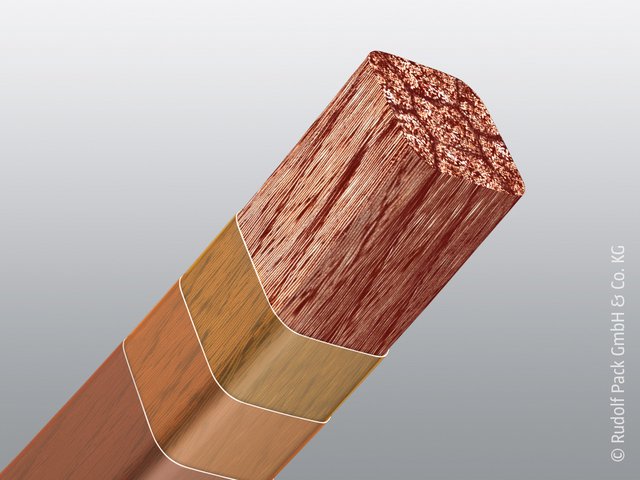
- Insulation Concept: To comply with the required dielectric strength, PACK LitzWire recommended the use of RUPALIT® Safety HF Litz Wires. These feature reinforced insulation systems, e.g., polyimide film (Kapton) or multi-extruded fluoropolymer layers (e.g., ETFE), which ensure high dielectric strength directly on the conductor. This allowed for a reduction of passive insulation materials (tapes) between the layers.
- Thermal Optimization: The optimized litz wire geometry led to a more homogeneous current distribution in the conductor package and thus to a more uniform thermal load.
Result
Through close technical coordination, a transformer design was realized that significantly reduced overall losses. The optimized HF litz wire enabled compliance with the required insulation distances while maximizing power density. The customer was thus able to bring a fast charging module into series production that remains thermally stable even under full load and meets the high safety requirements for public charging infrastructure.
RUPALIT® Safety Profile
This VDE-certified structure sets new standards for safety in power electronics. Experience significant size reduction and accelerated winding processes by eliminating separate layer insulation.
Technical questions deserve precise answers.
Would you like to coordinate specifications or request a sample production? Our specialist departments will advise you directly – competently, bindingly, and reliably.

Product Manager

Internal sales team